Group 3 Soft Wheat - Maximising Returns
Double-click to edit...
This is the first in a series of articles which will help to maximise the returns from our Group 3 Soft wheat programme, alongside our planned grower meetings.
Despite the current weather over the early part of 2026, there are some important jobs that need to be done prior to fertiliser applications. First of all, a soil mineral nitrogen test (SMN) will enable the Nitrogen programme to be optimised throughout the season to ensure yield and quality, while minimising environmental impact. Secondly, there is a good opportunity to take the first tissue analysis of the season as the crops wake up from the winter, guiding any micro nutrient top-up’s at this important time. Tissue analysis, combined with a Solvita test can provide all of this information in one useful report. If you have not done so already, contact your agronomist to send away a sample of last year’s grain for nutrient analysis. This can help greatly in determining the strategy for this season (more about this in subsequent updates).
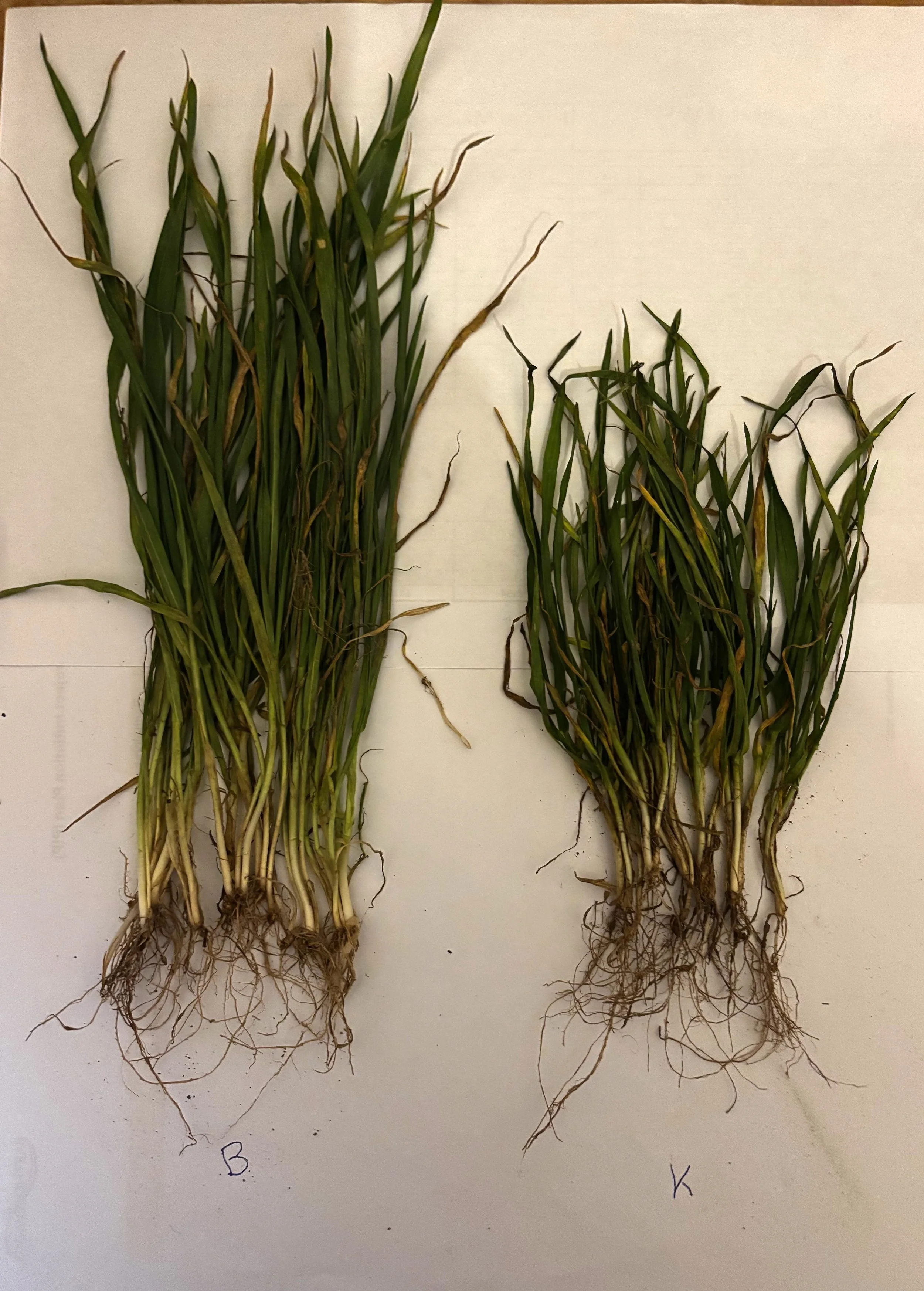
Getting out in the fields and looking at your crops from now on is very important, particularly under the ground. The attached picture shows two different plants dug up from our Hampshire trial site which clearly shows that no two varieties are the same, even sown under identical conditions/timing/seed rates. The variety on the left (Bamford) has a large amount of top growth and a modest root system, while the variety on the right (Kingsbury) has less top growth, greater tillering and more root mass. This clearly illustrates that the initial work we do under the ground in the next few weeks is very important. A simple inspection will help you plan this process to build maximum nutrient & moisture uptake, if the wheat plant is to remain resilient. All the Kingsbury seed supplied by Bartholomews this season was dressed with Ympact from Corteva, a seed treatment designed specifically for strong root development, which is clearly seen against the Bamford wheat plant which didn’t receive this treatment.
Both of our Group 3 Soft wheat varieties are capable of very high yields, providing specific flour specification characteristics for use in the Iberian milling & baking markets. As soon as the weather allows, Spring applications of Phosphate and Potash can be completed as well as the first Nitrogen and Sulphur feeds. Polysulphate or Potash plus products used at this stage can be a very good way of delivering Potassium and Sulphur, giving the underground rooting benefits that we regularly see from these products.